Erg Chebbi: Complete Guide to Morocco’s Largest Sahara Dunes
Erg Chebbi is the great sea of sand at the edge of the Moroccan Sahara, and it is the most famous desert landscape in the country. Its orange dunes rise up to about 150 metres above the plain, they stretch for roughly 22 kilometres from north to south, and they change colour from pale gold to deep red as the sun moves. The village of Merzouga sits at their foot, which makes the dunes easy to reach and easy to enjoy.
This guide explains everything you need to know about this desert: where it is, how it formed, how to get there, the best time to go, what to do on the dunes, how camps and camel treks work, and the small details that make a visit better. It is written for first-time visitors, couples, families and friends who want a real Sahara experience without a difficult expedition.
When you are ready to plan, our what to do in Merzouga guide lists every activity, and the 2 nights in Merzouga desert guide shows how to stay longer.
Erg Chebbi: The Short Answer
| Fact | Detail |
|---|---|
| Location | South-east Morocco, near Merzouga |
| Highest dunes | About 150 metres |
| Length | About 22 kilometres |
| Nearest towns | Merzouga, Hassilabied, Erfoud, Rissani |
| Best months | March to May and October to November |
| Classic activity | Camel trek and night in a camp |

What Is Erg Chebbi?
An erg is a large field of wind-shaped sand dunes, and Erg Chebbi is one of the two great ergs of Morocco. It looks like the desert of a postcard: smooth crests, sharp ridges and wide valleys of fine orange sand. The colour comes from iron oxide on the grains, and it shifts from honey to rose to copper through the day.
This sea of sand is not the whole Sahara, because the Sahara covers a huge part of North Africa. It is, however, the place where most visitors meet the desert for the first time, because the road ends at its edge and the camps are only minutes away. Many travellers say that the first view of the dunes at the end of the drive is one of the most memorable moments of their trip to Morocco.
- Size: big enough to feel endless, small enough to explore in a few days.
- Sand: soft, fine and warm, ideal for walking barefoot in the evening.
- Silence: there is no traffic, and the wind is often the only sound.
- Light: low sun makes long shadows and strong colours.
Where Is Erg Chebbi?
The dune field lies in the Drâa-Tafilalet region, close to the Algerian border. The nearest village is Merzouga, with Hassilabied and Khamlia along the western edge of the dunes. The larger towns of Erfoud and Rissani are about 50 and 35 minutes away by road, and they have shops, fuel, banks and markets.
The location explains the quiet and the clean sky. There is no big city nearby, so the air is dry and clear and the stars are bright. It also explains why the trip takes time: the dunes are far from Marrakech, Fes and the coast.
| From | Driving time to Merzouga |
|---|---|
| Fes | 7 to 8 hours |
| Marrakech | 9 to 10 hours |
| Ouarzazate | 6 to 7 hours |
| Errachidia | 2.5 hours |
| Erfoud | 1 hour |
How Erg Chebbi Formed
Erg Chebbi was shaped by wind over a very long time. The sand comes from ancient rivers and rocks that broke into tiny grains, and the wind carried it until it piled against a natural barrier and grew into dunes. This is why the field has such a sharp, clean outline against the flat gravel plain around it.
The region was once under a shallow sea, and fossils of ammonites and trilobites are found in the nearby hills. A visit to the workshops of Erfoud shows polished marble full of these ancient shells. It is a pleasant reminder that the desert you see today is only the latest chapter of a very long story.
Dunes also move. Strong winds slowly push the crests, and the shape of the field changes a little every season. A dune you climb in March may look different in November, which is one more reason to come back.
Getting to Erg Chebbi
Most visitors reach Erg Chebbi on a private tour from Fes or Marrakech, and the journey is part of the adventure. From Marrakech the road crosses the High Atlas, passes the UNESCO kasbah of Ait Benhaddou, follows the Dades Valley and the Todra Gorge, then reaches Merzouga in the evening. From Fes the road goes through the Middle Atlas cedar forests, Midelt and the Ziz Valley.
Because of the distance, most travellers split the journey with a night on the way. Our ready routes include the 2 days from Marrakech to Merzouga, the 3 days from Marrakech to Merzouga, the 2 days desert to Merzouga from Fes and the 4 days tour from Fes to Merzouga.
Public transport reaches Erfoud and Rissani, but the last stretch to the dunes is easier with a driver. A private car also lets you stop for photographs and tea in the villages of the Draa and Ziz valleys.
Riding a Camel on Erg Chebbi
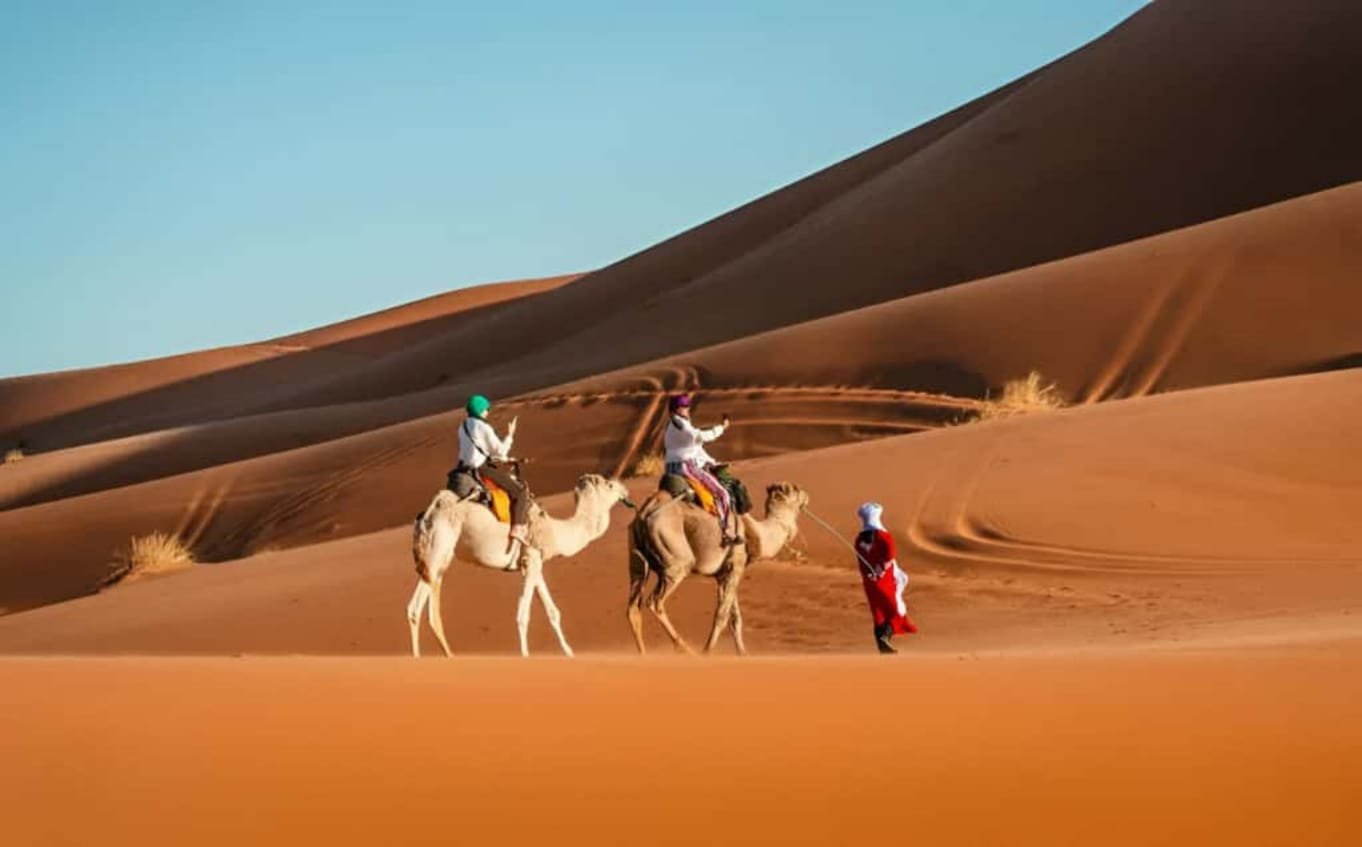
A camel trek is the classic way to enter the dunes. You meet your guide at a small auberge on the edge of the sand, wrap a scarf around your head and climb onto a kneeling dromedary. The caravan walks for about 60 to 90 minutes into the dunes, and the camp appears in a hollow between high crests.
The ride is calm and the camels are used to visitors. Mounting is the only awkward moment, because the animal stands up back legs first, so lean back and hold the saddle handle. After ten minutes the slow rhythm feels natural. For a full overnight plan, see our 2 days camel trekking in Merzouga guide.
Sunrise and Sunset on the Dunes
The two best moments on the dunes are the beginning and the end of the day. At sunset, the light turns orange and then red, and the shadows of the camels stretch across the sand. At sunrise, the air is cool, the dunes are quiet and the first rays make the crests glow. Many guests say that the sunrise is even better than the sunset because there are fewer people.
To see the sunrise, climb a tall dune about 45 minutes before the sun appears. The climb takes around 20 minutes on soft sand, and the view from the top covers the whole sea of dunes, the plain and the distant mountains. Wear a warm layer, because dawn is cold even in summer.

Camps and Nights on Erg Chebbi
A night in the dunes is the heart of a visit to Erg Chebbi. There are three types of camp. A traditional Berber tent has thick blankets and shared toilets. A comfortable private tent has real beds and a bathroom. A luxury tent adds a terrace, a heater in winter and sometimes air conditioning in summer. Our 1 night in Merzouga luxury camp guide compares them in detail.
Dinner is served around 20:00 with soup, a tagine and fruit, followed by drums and songs around the fire. After the music, walk a few steps away from the tents and look up. This area has one of the clearest skies in Morocco, and the Milky Way, planets and shooting stars are easy to see.

Activities on Erg Chebbi
The dunes offer much more than camels. You can try sandboarding on the highest slopes, ride a quad bike or a buggy between the dunes, take a 4×4 tour to the nomad camps, and walk alone on the quiet western ridge. Each activity gives a different view of the same sand.
Sandboarding
You climb a dune with a wooden board, strap in and slide down. The sand is soft and falls are harmless. It is fun for all ages, but the climb back is real exercise.
Quad bikes and buggies
Quad tours follow tracks along the edge of the dunes, and they are best in the morning. Engines are loud, so many guests choose one short ride and a slow camel trek on another day.
4×4 desert tour
A 4×4 reaches the nomad camps, the stone plain and the seasonal lake of Dayet Srji, and it suits guests who prefer comfort or cannot ride a camel.

Villages Around Erg Chebbi
The area around Erg Chebbi has several villages worth a stop. Merzouga is the main base, with auberges, shops and cafés. Hassilabied has a quieter feel and several family-run camps. Khamlia, a few kilometres south, is home to Gnawa musicians who play drums and iron castanets in their houses.
Rissani is the old market town, busiest on Sunday, Tuesday and Thursday, and a good place to taste medfouna, the local stuffed bread. Erfoud is known for date palms and polished fossil marble. A half-day tour can combine two or three of these places with a visit to the dunes.
Erg Chebbi or Erg Chigaga?
Morocco has two famous ergs, and visitors often ask which one to choose. Erg Chebbi is closer to the road, has more camps and is easier to reach, so it suits most first-time visitors. Erg Chigaga, near M’Hamid in the far south, is larger and wilder, but it needs a longer 4×4 journey and is more remote.
| Point | Erg Chebbi | Erg Chigaga |
|---|---|---|
| Access | Paved road to the edge | Several hours of 4×4 on tracks |
| Dune height | Up to 150 metres | Up to 300 metres |
| Camps | Many, all comfort levels | Fewer, more remote |
| Best for | First visit, short trips | Long trips, solitude |
If you have only two or three days, the closer erg is the better choice. For a shorter option near Marrakech, see the 2 days tour from Marrakech to Zagora.
Best Time to Visit Erg Chebbi
The best months are March, April, October and November, when days are warm and nights are mild. From December to February the days are pleasant, but nights can be close to freezing, so a camp with heavy blankets or a heater is important. May and September are hot but possible. From June to August, temperatures can pass 40 degrees, and activities move to early morning and late evening.
Whatever the month, a visit to the dunes is memorable. Winter gives crisp air and deep colours, spring has a soft light and sometimes a green plain after rain, and autumn has stable weather and long evenings.
Weather, Wind and Safety
Wind is the main thing to watch on the dunes. Spring sandstorms are rare but possible, and your guide will change the plan to keep you safe. Bring a scarf for your nose and mouth, and sunglasses for the sand. In summer, drink water all day and avoid walking on the dunes at midday.
The area is calm and used to visitors. Use licensed local guides, follow their advice and stay close to the camp at night. For a broader answer to safety questions, read is Morocco safe to travel.
What to Pack for Erg Chebbi
- Clothes: light layers for the day and a warm jacket for the night.
- Head and face: a scarf, a hat and sunglasses.
- Shoes: closed shoes for the dunes and sandals for the tent.
- Small bag: only the essentials, because large bags stay at the auberge.
- Tech: a phone with a dust cover, a power bank and a headlamp.
- Care: sunscreen, lip balm and wet wipes.
Photography Tips for Erg Chebbi
The best light is within an hour of sunrise and sunset, when the sun is low and the dunes show soft curves. Walk early to leave clean footprints in front of the lens, and look for lines of ridges that lead the eye. A person or a camel gives scale to the photograph.
Protect equipment from sand with a cloth and a zip bag, and change lenses inside the tent. For night photographs, use a small tripod and a long exposure of about 20 seconds. The dark sky above the dunes gives clear stars even with a phone camera in night mode.
Plans by Length
| Stay | Plan |
|---|---|
| 1 night | Arrive by 16:00, sunset camel trek, dinner, camp, sunrise, breakfast and return |
| 2 nights | Add sandboarding, a 4×4 tour with Khamlia and a nomad tea, and a second night with stargazing |
| 3 nights | Add Rissani, the fossils of Erfoud, Dayet Srji lake and a free afternoon |
One night is the minimum, but two nights let you relax and see more. If your time is limited, browse all Morocco tours or our Morocco itineraries for routes that include the dunes.
Mistakes to Avoid
The biggest mistake is arriving after dark. You lose the sunset ride, which is the best part of a visit to the dunes. Plan to arrive by 16:00 in winter and 17:00 in summer. Other common errors are wearing sandals on the camel, bringing a large suitcase, forgetting a warm layer in winter and choosing a camp only because it is cheap.
Do not try to see all of Morocco in one week and give the desert only an evening. The dunes reward slow travel, and a second night is often the best decision a guest makes.
Responsible Travel on the Dunes
The desert is a fragile place and a home for local families. Take all litter with you, avoid driving off the main tracks, and never buy loose fossils from protected areas. Treat camels kindly, and choose operators who never overload or beat the animals.
Choose camps that use solar power, manage water carefully and employ local staff. When you book with a local team, your money supports families who live near the dunes all year, not only in the tourist season.
Frequently Asked Questions
Where is Erg Chebbi?
Erg Chebbi is in south-east Morocco, near the village of Merzouga and close to the Algerian border.
How high are the dunes of Erg Chebbi?
The tallest dunes reach about 150 metres above the plain, and the whole field is around 22 kilometres long.
How many days do I need for Erg Chebbi?
One night is the minimum. Two nights give time for sandboarding, a 4×4 tour and a second evening under the stars.
Is Erg Chebbi safe for tourists?
Yes. The area is calm and used to visitors. Use licensed local guides and follow their advice about wind and heat.
What is the best time to visit Erg Chebbi?
March to May and October to November are the most comfortable months. Winter nights are cold and summer days are very hot.
How do I book a trip to Erg Chebbi?
Send your dates and the number of travellers on WhatsApp at +212 682 832 176 or through our contact page. We reply with a quote made for you.
Ready to Visit Erg Chebbi?
Tell us your dates, the number of travellers and the kind of camp you like. We will send a clear, personal plan for your visit to the dunes.
Leave a Reply